
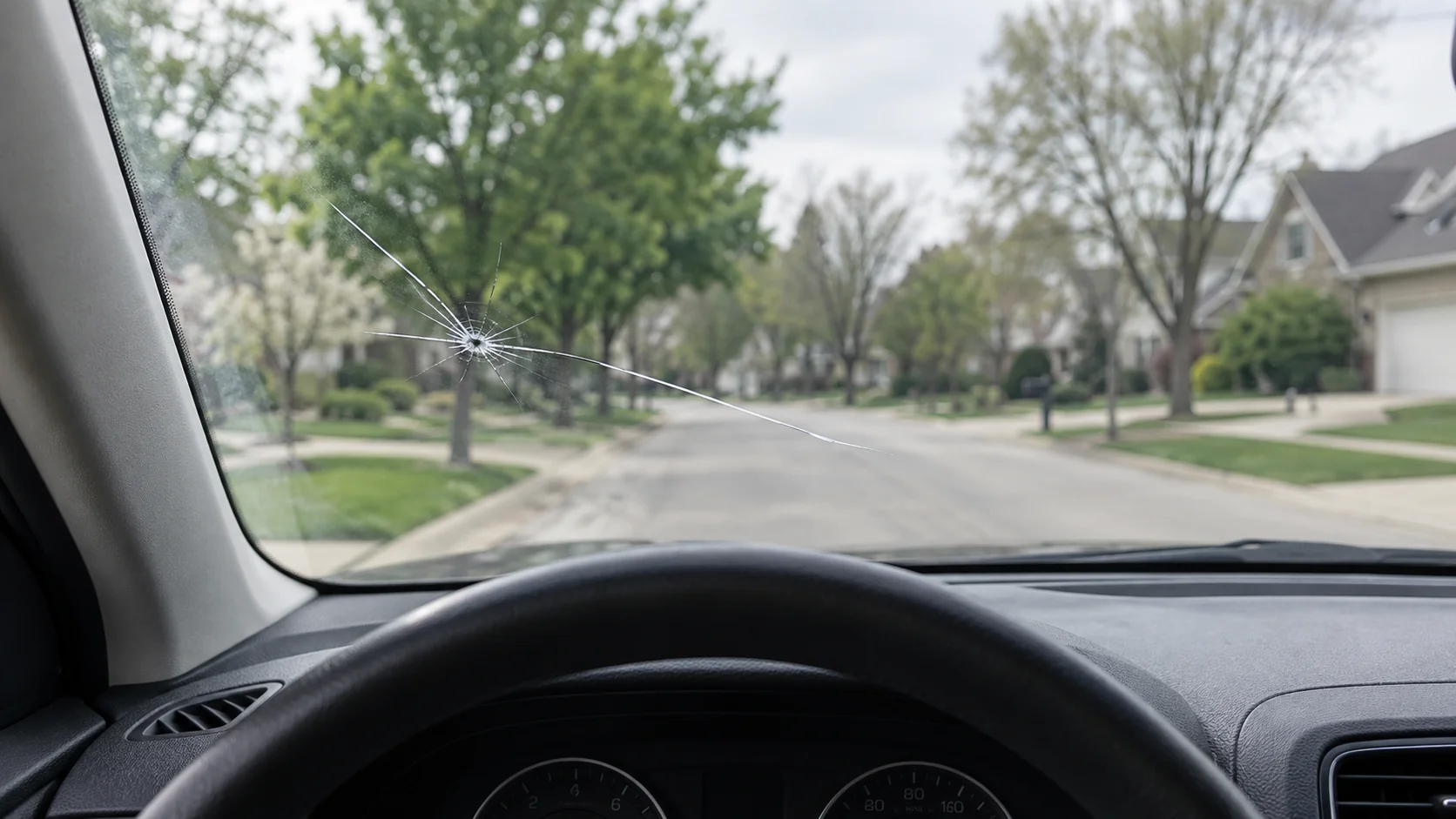
What Illinois law says about damaged glass
Section 12-503 of the Illinois Vehicle Code is titled "Windshields must be unobstructed and equipped with wipers." Subsection (e) covers damage: no person shall drive a motor vehicle when the windshield, side or rear windows are in such defective condition or repair as to materially impair the driver's view to the front, side or rear. There is no crack length and no chip size in the statute. The test is whether the damage materially impairs the view. For the rear window only, the same subsection deems a car with compliant side mirrors on both sides to comply even if the rear window is obscured.
A windshield is required in the first place
Section 12-501 requires every motor vehicle driven on Illinois highways to have a front windshield, with exceptions such as motorcycles and some antique and custom vehicles. It also makes it unlawful to knowingly install glazing that is not approved safety glazing, and ties the glazing standard to the federal rule, FMVSS 205.
Stickers, tint and hanging objects
Subsection 12-503(a) bars signs, posters, window applications and tinted film on the front windshield, except nonreflective tinted film along the top that extends no more than 6 inches down. Subsection (h) exempts stickers and certificates that state or local authorities require to be displayed. Subsection (c-5) bars objects hung or placed between the driver and the windshield that materially obstruct the view.
Illinois rules at a glance
| Rule | What it says (plain English) | Source to cite |
|---|---|---|
| Obstructed view | No objects hung or placed between the driver and the windshield that materially obstruct the view | 625 ILCS 5/12-503(c-5) |
| Windshield required | Every motor vehicle on Illinois highways needs a front windshield, with limited exceptions such as motorcycles | 625 ILCS 5/12-501(a) |
| Wipers | Every motor vehicle except a motorcycle needs a driver-controlled device to clear rain, snow and moisture | 625 ILCS 5/12-503(d) |
| Tint and non-reflective film | Film only along the top of the windshield, no more than 6 inches down | 625 ILCS 5/12-503(a) |
Swipe the table sideways to see every column.
The Cook County six-inch rule, and where it applies
Cook County Code section 82-128(b) says no person shall operate or park a vehicle on any roadway under the County's jurisdiction if any window is missing, broken, or cracked with a crack longer than six inches. Two limits matter. It covers any window, not just the windshield. And the County's vehicle code applies to County property, to public ways under County jurisdiction in unincorporated areas, and to municipal streets only where the County has an agreement to enforce there. It is not a statewide rule, and it does not apply on Alsip's village streets by default.
Commercial vehicles
For commercial motor vehicles, 49 CFR 393.60(c) requires the windshield to be free of damage in the area above the top of the steering wheel, excluding a 2-inch border at the top and 1-inch borders at the sides. It allows a crack not intersected by another crack, and damage that a 3/4-inch disc can cover if it is at least 3 inches from other such damage. The rule applies only to vehicles that meet the federal commercial motor vehicle definition.
What this means for a crack
Legally, the question in Illinois is visibility. Practically, a crack in front of the driver is also the one a repair technician is least able to fix. If yours is there, the repair-or-replace guide explains the limits, and windshield replacement covers the job. This guide is general information, not legal advice about a ticket.